Introduction
Creating a professional profile can be difficult for many job seekers, especially those who are more comfortable speaking than typing. For workers, freshers, and candidates from different language backgrounds, traditional forms can become a barrier to finding the right job.
As part of a job portal project, we wanted to make profile creation simpler and more accessible. Our approach was to build a voice-based profile creation experience that allows candidates to answer questions naturally using their voice.
This blog explains the architecture behind our Speech-to-Text (STT) voice-fill pipeline, the challenges we faced, and the engineering decisions that help make the system reliable and scalable.
Why Voice-Based Profile Creation?
Traditional profile forms require candidates to enter information manually, including their professional experience, education, skills, location, and expected salary.
For many users, this process is time-consuming or uncomfortable.
A voice-based experience offers several advantages:
Candidates can answer questions naturally.
Less typing is required on mobile devices.
Users can communicate in supported regional languages.
The profile creation process becomes more conversational.
The experience can support candidates who are less comfortable with complex digital forms.
However, converting speech into a useful, structured profile is more complicated than simply converting audio into text.
Understanding the STT Pipeline
Our voice-fill pipeline follows a sequence of steps:
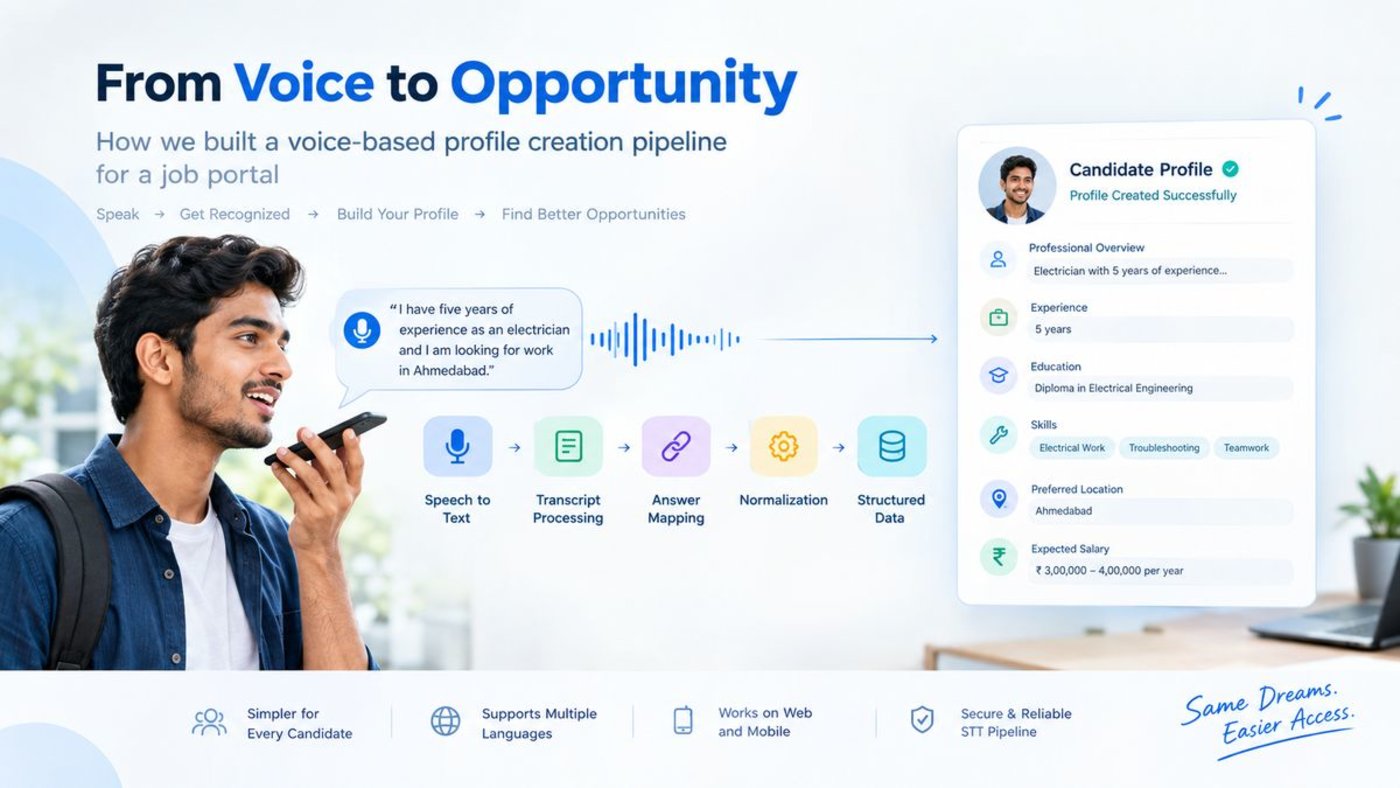
Audio → Speech-to-Text → Transcript Processing → Answer Mapping → Normalization → Profile Review → Submission
Each step has a specific responsibility.
The goal is not just to generate a transcript. The system must understand which question the candidate answered, preserve the meaning of the response, and prepare the information for the appropriate profile field.
1. Capturing the Candidate's Voice
The process begins when the candidate starts answering a question.
The client application manages:
Microphone permissions.
Audio recording.
Recording status.
Audio streaming.
Interim transcript display.
Final transcript handling.
Retry and error states.
The experience should remain simple. Candidates should know when recording has started, when it has stopped, and whether their answer was successfully understood.
A typed-input fallback is also important because microphone permissions, device limitations, or network conditions may prevent voice input from working.
2. Converting Speech into Text
We use Google Speech-to-Text as the recognition layer.
The system supports language configurations such as:
English:
en-IN, withen-USas an alternative.Hindi:
hi-IN, with additional English alternatives where appropriate.
The STT service receives audio and returns transcript events. These events may contain interim text while the candidate is speaking and a final transcript when the answer is complete.
Interim results are useful for providing live feedback, but they should not be treated as the final answer.
3. Handling Interim and Final Transcripts
One of the important distinctions in a voice pipeline is the difference between interim and final results.
An interim transcript may change as the speech recognition engine receives more audio. A final transcript represents the completed recognition result for an utterance.
Our application should therefore keep these states separate:
Interim transcript: temporary text for live feedback.
Final transcript: completed recognition result.
Confirmed answer: the candidate-approved answer that can be used for profile data.
This separation helps prevent incomplete or changing speech recognition results from overwriting a candidate's confirmed information.
4. Mapping Answers to the Correct Questions
A profile creation flow contains multiple questions. For example:
Please introduce yourself.
What is your total work experience?
What is your highest educational qualification?
What is your expected salary?
Which skills do you have?
The system must ensure that every answer is associated with the correct question.
We use stable question keys, such as:
PROFESSIONAL_OVERVIEW_1
A voice session should track the active question, the candidate, and the recording attempt.
This is more reliable than depending only on array indexes or the current position in the UI.
5. Normalizing Speech into Structured Data
Speech recognition produces text, but profile systems need structured information.
For example, a candidate might say:
I have five years of experience as an electrician and I am looking for work in Ahmedabad.
The system may extract information such as:
Profession: Electrician
Experience: 5 years
Preferred location: Ahmedabad
Normalization should be field-aware and conservative. It should improve formatting without changing the candidate's meaning.
For salary, experience, education, and other structured fields, validation is especially important. If the system is uncertain, the candidate should be able to review and correct the extracted information.
We should also preserve the original transcript separately from the normalized value. This makes debugging and future improvements easier.
6. Session Management and Account Isolation
One of the most important lessons in a voice-based system is that session state must be isolated.
A candidate's questions and answers should never appear in another candidate's session.
A voice session should have a unique identifier and be associated with the authenticated user. The Socket.IO socket.id can be useful for diagnostics, but it should not be treated as a permanent user identity because it can change after reconnecting.
Client-side draft state must also be handled carefully. If voice answers are stored locally, the storage should be scoped to the user and profile flow.
When a candidate logs out, switches accounts, or restarts the flow, stale voice data must not be reused.
7. Reliability: What Happens When Something Goes Wrong?
Real-world voice applications operate under unpredictable conditions.
A candidate may have a slow network connection, background noise, a microphone permission issue, or an interruption while speaking.
The pipeline should handle these situations gracefully.
Important recovery scenarios include:
Microphone permission denied.
Empty or silent recording.
Socket disconnection.
Speech recognition timeout.
Malformed audio.
Duplicate transcript events.
Stale session events.
Provider errors or rate limits.
The user should receive a clear message and an opportunity to retry or use text input instead of being blocked.
8. Logging and Debugging
A voice pipeline involves several moving parts: the client, Socket.IO, the STT provider, transcript processing, and profile persistence.
Without proper logging, it can be difficult to determine where a failure occurred.
Useful correlation fields include:
Session ID.
Question key.
Recording attempt ID.
Language.
Provider.
Event type.
Processing duration.
Error code.
Sensitive information should be redacted from logs. Raw audio and complete personal transcripts should not be logged by default.
Metrics such as transcript success rate, retry rate, empty-transcript rate, and time to final transcript can help identify production issues.
9. Designing for Web and Flutter
The same backend should support both the web application and future Flutter clients on Android and iOS.
The key is to keep the backend contracts platform-neutral.
The web and mobile clients should use the same concepts:
Authenticated voice sessions.
Stable question keys.
Recording attempt IDs.
Interim and final transcript events.
Normalized answer formats.
Consistent error codes.
However, audio capture is different across platforms. Flutter clients must handle native microphone permissions, audio formats, app interruptions, and background or foreground transitions on Android and iOS.
A shared backend contract allows each client to implement its own recording experience while maintaining consistent profile behavior.
10. Future Improvements
The voice-fill pipeline can evolve over time.
Potential improvements include:
Better field-aware answer normalization.
More language support.
Improved handling of mixed-language speech.
Stronger session recovery.
More detailed performance monitoring.
Provider abstraction for future STT services.
Automated testing for network failures and account switching.
Improved candidate confirmation and correction flows.
The architecture should make these improvements possible without rewriting the entire profile creation system.
Conclusion
Building a voice-based profile creation experience is not just a speech recognition problem. It is a combination of audio processing, real-time communication, session management, structured data extraction, validation, and user experience design.
For this job portal project, the goal is to make job profile creation easier for candidates across different backgrounds and levels of digital comfort.
A reliable STT pipeline can help turn a complicated form into a more natural conversation, while careful engineering ensures that the resulting profile data remains accurate, secure, and useful.
Discussion (0)
No comments yet. Be the first to share your thoughts on this architecture!